A Dynamic Framework for Writing Fluency
Bridging the “What” and “How” of Writing
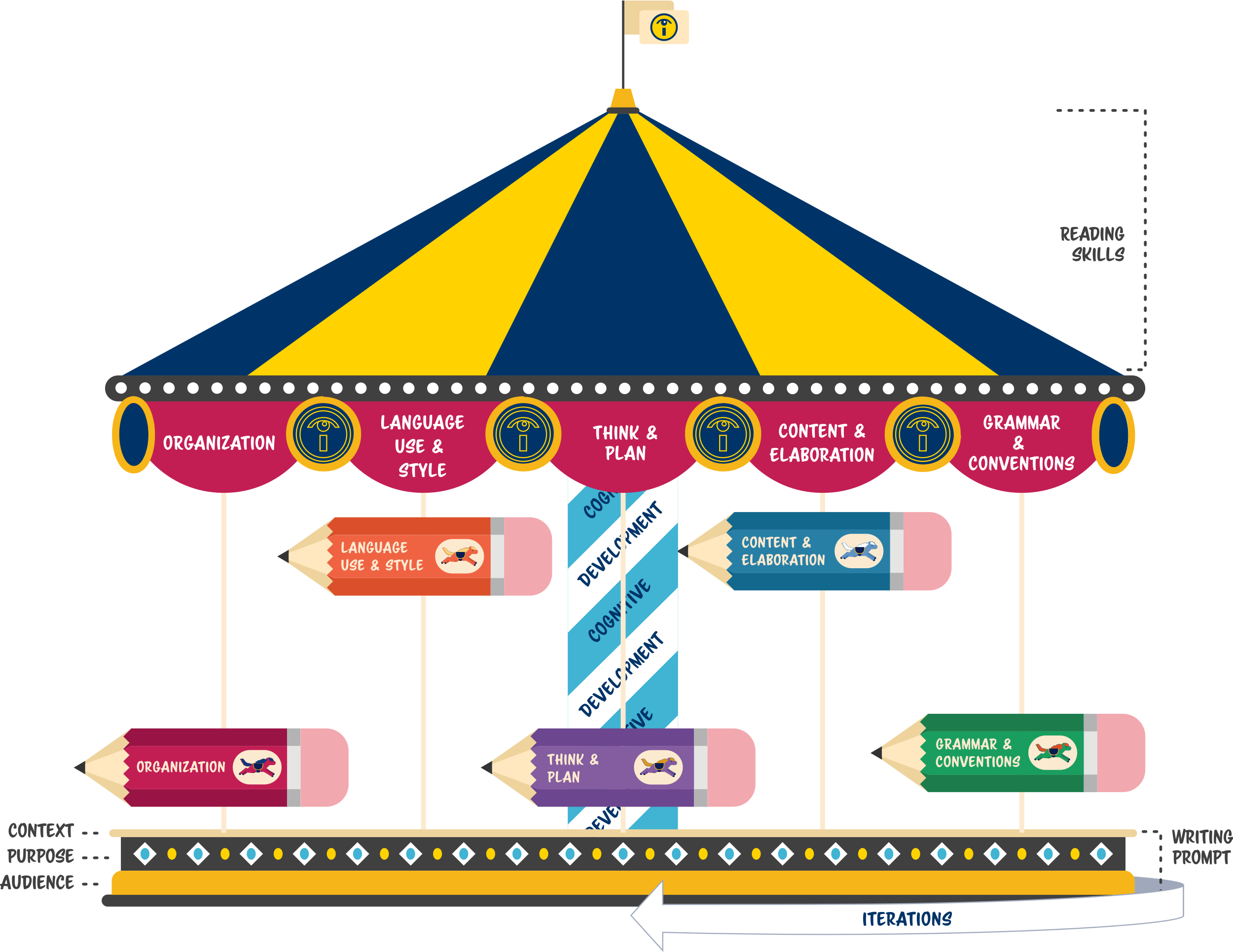
The Writing Carousel represents the recursive writing process that unfolds as students plan, organize and communicate their thoughts in writing. It shows not only what, but also how students become proficient writers.
Writing is not linear; it’s iterative and continuous.
The Platform & The Ride

The Canopy: Reading Knowledge
Above the carousel, the canopy represents reading and background knowledge, the rich store of vocabulary, comprehension, and text structures that guide a writer’s choices. Because reading and writing are reciprocal, what students read directly expands what they can write.
The Poles: Oral Language
The vertical poles connecting the canopy to the platform symbolize oral language—the foundation of literacy. Spoken language connects reading and writing, grounding students in the ability to express and organize thought before encoding it in print.
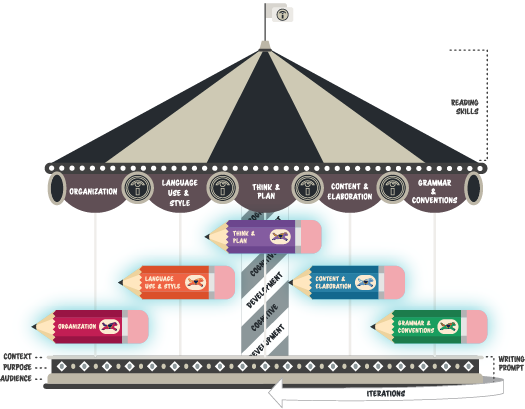
The Riding Stations: Five Domains of the Writing Rope
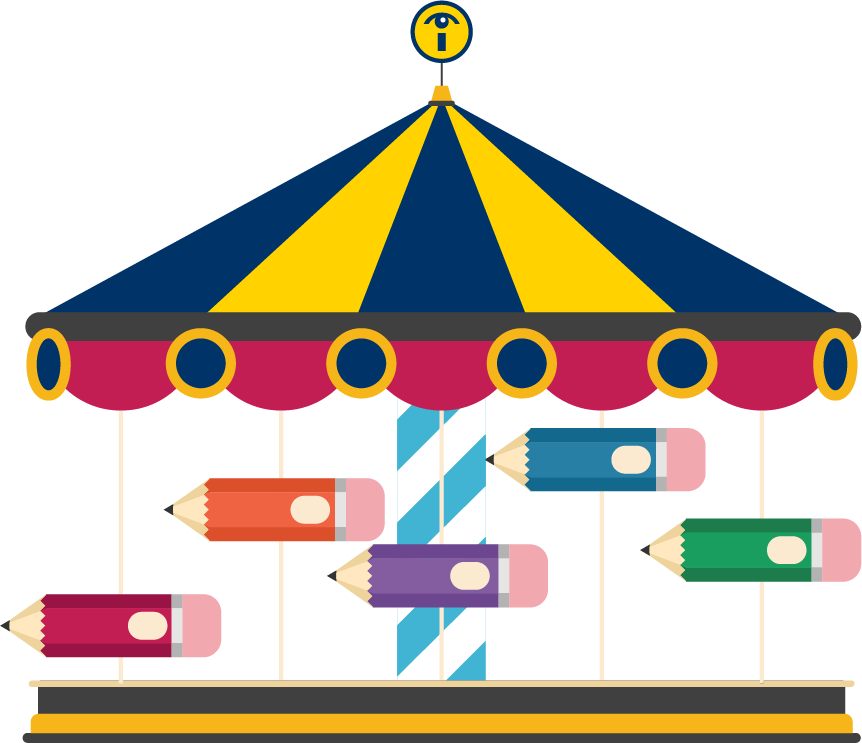
Many of us picture the heart of a carousel as the beautiful horses we ride as we go around. In the Writing Carousel, the horses are pencils. Each pencil represents a writing domain, and every rotation offers another opportunity for reflection, revision, and growth.
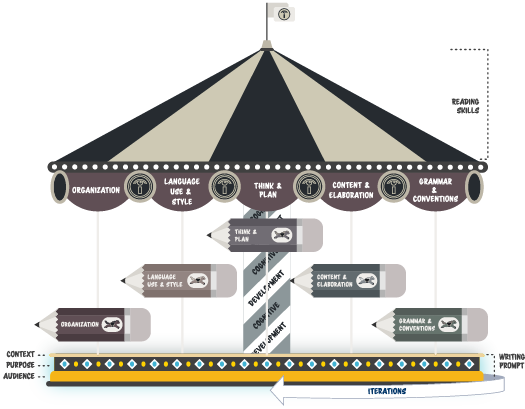
The Platform: Purpose, Audience, and Context
The carousel platform is built on a strong writing prompt that clarifies who you’re writing for, why you’re writing (to describe, inform, persuade, or tell a story), and what you’re writing about. his platform defines the purpose, audience, and context for every piece of writing.
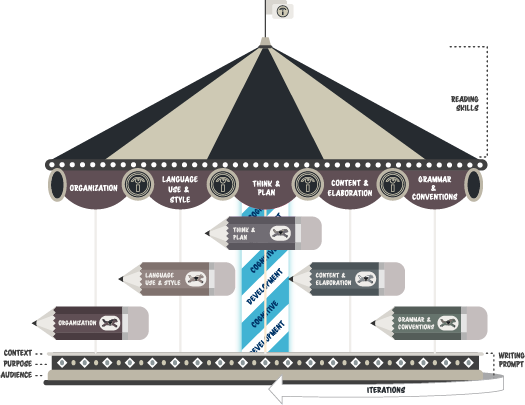
The Center Pole: Cognitive Development
At the heart of the carousel is reflection and metacognition—the self-awareness that allows students to monitor and improve their own writing. Clearly shown in brain studies of writing and in classroom writing strategies, this central operation around which all others rotate represents the executive function that drives skilled writing: setting goals, evaluating progress, and revising purposefully.
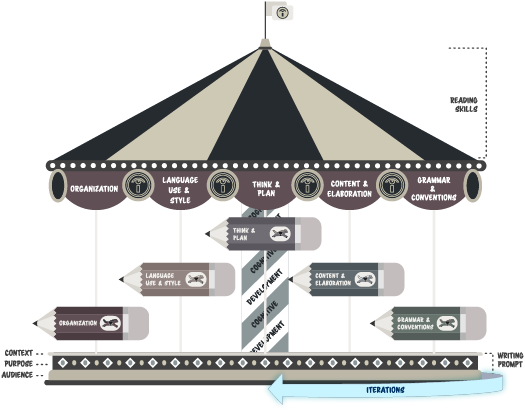
Riding the Carousel: Evidence-Based Practice in Motion
Even experienced writers revisit these domains multiple times, sharpening their focus, strengthening their structure, and elevating their expression with every pass. This repeated cycle of revision, even for the very best writers, is what makes the carousel such a powerful representation of the writing process.
The Writing Carousel is not just a metaphor. It’s a movement model for writing instruction: recursive, inclusive, and endlessly engaging.
The Five Domains of the Writing Carousel
Why the Writing Carousel Matters
The Writing Carousel unites science and artistry in writing instruction. It’s grounded in:

Neuroscience
Recognizing that writing builds cognitive capacity.

The Writing Rope
Showing the interconnected “strands” of skilled writing.
Evidence-Based Pedagogy
Supporting teachers with structured, practical tools.

For educators, it offers:
- A shared language for instruction across grade levels.
- A framework for differentiation, showing where a student is thriving or needs targeted support.
- A visual and conceptual model that connects writing to reading and oral language— three inseparable dimensions of literacy development.
Aligned with the Science of Writing
For years, schools and districts have embraced the Science of Reading, the body of research explaining how students learn to read through phonemic awareness, decoding, fluency, vocabulary, and comprehension. These efforts have transformed early reading instruction and assessment.
Now, education is entering a new chapter: the Science of Writing.
Writing is not simply the next step after reading; it’s an equally essential, distinct process that activates different parts of the brain and deepens comprehension, reasoning, and communication. Districts that have built strong reading foundations are now ready to complement that success with focused writing instruction to accelerate overall literacy growth.
The Frameworks of Literacy
Weaving Reading, Writing, and Language
For years, schools and districts have embraced the Science of Reading, the body of research explaining how students learn to read through phonemic awareness, decoding, fluency, vocabulary, and comprehension. These efforts have transformed early reading instruction and assessment.
Now, education is entering a new chapter: the Science of Writing. Writing is not simply the next step after reading; it’s an equally essential, distinct process that activates different parts of the brain and deepens comprehension, reasoning, and communication. Districts that have built strong reading foundations are now ready to complement that success with focused writing instruction to accelerate overall literacy growth.
The Final “Strand” in the Science of Writing
The Writing Carousel builds on this foundation by showing how those strands work together in an ongoing, dynamic process. It transforms the static rope model into a living, cyclical experience that mirrors how writers actually think, plan, draft, and refine their work.
The Writing Rope explains what writers must know.
The Writing Carousel shows how writers grow.
A Process, Not a Line
Unlike a linear writing process, the carousel never stops. Each rotation represents another opportunity to reflect, revise, and improve. This imagery captures what teachers already know: writing isn’t a one-way journey but a continuous cycle of growth. Students ride through stages repeatedly, gaining sophistication with each turn.